


CLIFFORD STONE
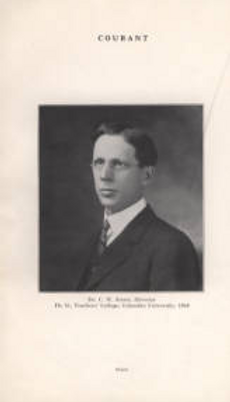
CLIFF W. STONE
The first Laboratory School building, Sabin Hall, was called an “educational palace” when it opened in January 1914. Designed to be a model school building, the four-story structure was a place where Iowa State Teachers College (ISTC) students could receive instruction on the best teaching methods and then have the chance to practice what they had learned in real classrooms under the observation of experienced teachers. The new building provided rooms for classes from kindergarten through high school and housed a library of 3,000 volumes as well as motion picture equipment, phonographs, and a player piano. When it opened, the new “Training School” (as it was called) had 25 teachers, some 350 students, and—over the course of the year—about 500 student teachers.
With the new school came Dr. Cliff W. Stone as Training School Head, a role enlarged in 1916 to include Directorship of the Department of Teaching. Stone began the long tradition of Lab School leadership in math education and forged the link between ISTC and the Teachers College of Columbia University in New York City, the oldest (1887) and largest graduate school of education in the United States.
Stone was born in Wisconsin in 1874 and was raised on a farm. He graduated from the State Normal School at Oshkosh, Wisconsin in 1899, and soon after began his long career as a teacher, principal, and director of teaching.
Math Teaching Usefulness
As a principal in Indianapolis, Indiana in 1903, he co-authored an article in The Elementary School Teacher titled “Arithmetic Considered as a Utilitarian Study: What Should Be the Course of Study?” The three authors conducted interviews of twenty leading Indianapolis business people with the goal of discovering how to square math teaching with real world use.
The business leaders were given a copy of John W. Cook’s and Nebraska C. Cropsey’s book Arithmetic and left with six questions:
-
Check such divisions of the table of contents as you consider of no use in business.
-
Indicate the most important subjects in order of their value.
-
Add such other subjects as you believe would be of value to a business person.
-
Tell us wherein you have found your employees strong in arithmetic and wherein weak
-
In which do you consider pupils should receive more drill—in oral (mental) or written arithmetic?
-
Give us a summary of what you think schools ought to teach below the high school, and how the teaching may best be made real to the pupils.
Among some fifteen subjects named as of no use in business transactions were measurement of cones, pyramids, and the circle; the right triangle; longitude; and the international date line. The business leaders suggested that valuable additions would be personal accounts and elements of bookkeeping—single and double entry. Of their employees’ mathematical strengths, the leaders were “uniformly silent,” citing none. They found their employees especially weak in accuracy of addition and multiplication, and in their ability to handle problems involving decimals and percentage.
Andrew M. Sweeney, the President of the Indiana State Life Insurance Company, offered this rousing summary: “To make the subjects in arithmetic real, each one should be approached from the concrete side, and following upon this should be an immense amount of mental drill by which the pupil is compelled to do much thinking, talking, and explaining. This process should be faithfully, I might say slavishly, pursued, until speed and accuracy are positively numbered among the pupil’s powers. Review! Review!! Review!!!”
Stone and his colleagues concluded that arithmetic teachers were attempting to teach too many subjects to teach all of them well. To answer Sweeney’s call to impress students with the use of arithmetic in real world affairs, Stone urged math teachers to adopt several concrete class projects. (These anticipated the project-based Lab School science curricula that took flight in the 1950s.)
A project to show the value of measurement involved a 7th-grade class in building a house to scale. “The utilitarian value of lumber measure was immediately apparent,” Stone explained, “and as the house progressed the need of being able to compute surface measure for lathing, plastering, papering, and carpeting became very real.”
A second 7th-grade math class discovered the various applications of percentage when each member was placed as a new employee in a hypothetical grocery store. Stone explained that:
Some of the advantages of selecting the grocery business for this particular class are seen in the facts that fully one-third of the pupils had either parents or near relation in the grocery business, fully one-third of the boys had worked in a grocery store, and all the pupils lived in easy reach of the corner grocery [owner], of whom they were required to get their knowledge first hand. The pupils were encouraged to secure order blanks, actual bills of goods, etc. from their grocery adviser. . . . From bills secured of grocers, children learned usual discounts, and made bills of their own.
Besides bills and their discounts, interest on overdue bills, gain-and-loss computations, taxes, insurance, and even commissions became necessary to compute. Stone noted that:
At this point the pupils readily realize the utilitarian value of drill in addition.
. . . The matter is no longer one between the teacher and pupil, but the situation has become that of a business relation. So readily is this transition made from the imagined boy to the pupil himself that in the first week’s work pupils had of themselves begun to speak of “Flora’s bill,” “Thomas’s order,” etc. and so real does this become that it is expressed in the titles of some of the notebooks, e.g., “My Experience in the Grocery Business.” With a class in this condition the teacher may give as long and otherwise tedious columns of numbers for addition drill as desired . . . . The arithmetic is no longer dictation work. The motive is from within.
The same proved true regarding percentage of gain or loss; many students also found themselves lamentably weak in decimal computations. Stone wrote that
[i]t required no urging from the teacher to get these pupils to do the most grind kind of drill work for getting the decimal point in the right place. They seemed to feel that their employers could not retain them unless they improved. Boys who seemed on the verge of dropping out of school were caught in this scheme and their whole work improved. . . . A boy who had never done anything for anybody became so enthusiastic with his work that . . . he was allowed to take eighth-grade arithmetic in addition to seventh-grade work.
For the eighth graders, a school bank was created to study interest and its applications.
Arithmetic Testing
Stone built on his real-world focus by becoming an early pioneer in math testing. He pursued his studies at Columbia University’s Teachers College, where he earned a bachelor of science degree in 1904 and a Ph.D. in 1908. His doctoral dissertation, published in 1908, was titled Arithmetical Abilities and Some Factors Determining Them.
This work established Stone’s lasting fame as the creator of the Stone Tests of arithmetic operations and reasoning. Stone involved 26 school systems in his carefully controlled study: 6 in New England, 11 in New York and New Jersey, and 9 in the Middle West. Nineteen were public schools, 4 training schools, and 3 private schools. Superintendents and principals identified 6th grade classrooms in which an approved course of arithmetic study had been carried out in the past 5 l/2 years or more. These 6th graders would help establish a standard for use in comparing national arithmetic abilities.
Stone personally gave his two tests himself in each classroom to make conditions uniform. His test for “Fundamental Arithmetic Operations” (addition, subtraction, multiplication, and division) consisted of 14 problems. The sixth graders were told to do as many of the problems as possible in the 12 minutes allowed for this test. (Problem 1 was to add 6 (mostly 4-digit) numbers; Problem 2, to multiply 3265 x 20; Problem 3 to divide 3328 by 64, etc.) Stone’s “Reasoning in Arithmetic” test was comprised of 12 problems to be done in order in 15 minutes. (Problem 2 was: John sold 4 Saturday Evening Posts at 5 cents each. He kept l/2 the money and with the other l/2 he bought Sunday papers at 2 cents each. How many papers did he buy?) Test trials had shown that all the students could finish the first 6 problems in each test within the time-frames; the remaining problems were for fast workers.
The 6,000 6th grade test papers collected revealed startling facts—even for today. No correspondence existed between how well a given school system’s students did in arithmetic operations and how its students did in arithmetic reasoning: most differed greatly. Additionally, of the 4 arithmetic operations, addition was found to be not only just as hard as subtraction, multiplication, and division, but even harder than the others to do correctly. The difficulty in accuracy decreased from addition to subtraction and multiplication and became least in division. Both of Stone’s tests also showed a striking difference in accuracy among individual 6th graders, leading him to urge educators to consider whether it was “right from any standpoint to expect to treat children as if they could and ought to do equally well in all subjects, or even in all phases of the same subject?”
Stone’s study also showed no relationship between the time the school systems spent on instruction and the students’ achievement in arithmetic operations and reasoning. In short, “a large amount of time expenditure [was] no guarantee of a high standard of abilities.” Stone and his readers then scored the actual 6-year math curricula for each school which led him to the sentences that made his work so persuasive to teachers and administrators in 1908 and after: “That the great variability herein shown would exist if school authorities had adequate means of measuring products is inconceivable; and it is believed that the present study will help standardize the work in arithmetic for the first six grades. Anyone who wishes can know how his system or school compares with the representative systems of the country.” Stone concluded this unfolding of what would become known as the Stone Tests with this caution: “Doubtless the most helpful generalization possible from this study is that there is no one factor that produces abilities, that there is no summum bonam [highest good] in teaching arithmetic.”
Scientific Study of the Teaching of Arithmetic
Following his Columbia Teachers College days, Stone became Head of the Department of Education and Director of the Training School at the State Female Normal School in Farmville, Virginia (today Longwood University). In 1913, his article “Problems in the Scientific Study of the Teaching of Arithmetic” appeared in the Journal of Educational Psychology. It reveals why he was an ideal choice for Iowa State Teachers College and its soon-to-be-opened model Training School.
Stone addressed two questions in the article: What arithmetic ought to be taught? And how can this arithmetic be taught best? The second question led to his call, not only for testing of current practices, but also encouragement of teachers to attempt methods comparisons—with direct help in how to do so. Stone laid out important method questions related to the teaching of addition, subtraction, multiplication, division, fractions, denominate numbers, percentage, interest, reasoning, etc. One general question was “How much of the work should be oral rather than written?” He then wrote (sounding like the director of a laboratory school): “The question could probably be most readily studied by a single teacher or group of teachers in departmental teaching, though a teacher of one grade can divide her class into two groups, equal as to arithmetical ability, and do much toward answering the question.” Regarding addition, two questions that could be tested were: “Which is better, to add up or down the columns? and Does it pay to write down the numbers to carry?”
In this encouraging article, Stone sought to ease fear of methods study in teachers and administrators. He noted that:
Teachers often hesitate . . . thinking that anything in the nature of a departure is an experiment, and therefore dangerous. This hesitation is not usually justified, for even if results show that some groups have been somewhat at a disadvantage, it can be made up to them very readily after the controlled testing is completed. It will be noted that here, as elsewhere in this discussion, the word experiment is not used. This is done because the word has come to suggest something radical, dangerous, and therefore to be avoided.
Stone urged testing at the beginning of the year, middle, and end—and then at the start of the next year to discover vacation loss. He suggested similar testing at the beginning and end of separate units.
Stone showed himself even more Socratic in his effort to answer his first vital question: What arithmetic ought be taught? Here he asked teachers, administrators, and citizens to investigate scientifically the worth of subject matter to be taught both in practical and cultural terms. As he put it: What Arithmetic is needed in order best to make a living? and What Arithmetic is needed in order to make the best living? For the latter, he asked What arithmetic help is needed by the developing child to best further the respective stages of his or her growth? Furthermore, to what extent is the discipline of the respective parts of arithmetic transferable to other subjects?
Stone focused on these issues while at ISTC, and he also built on his 1908 Arithmetical Abilities and Some Factors Determining Them. Finding that most work was being done in arithmetic operations, he published in 1916 Standardized Reasoning Tests in Arithmetic and How to Utilize Them, refining his 1908 reasoning test. This book was revised and enlarged in 1921 and has been reprinted many times since—the last in 2022.
Local & Global Crises
The brand new “educational palace” awaited Stone when he arrived on the ISTC campus in 1914, a building solely devoted to the College’s Training School. The first years must have seemed promising and hopeful—despite the August 1914 start of World War I. However, Stone’s last few years brought unexpected challenges and grief. As Robert and Katherine Martin explain in “The Lab School Story,” the school’s formal history:
“had [Stone] been able to devote himself primarily to the routine details of administering a department and campus training school, things might have gone more smoothly. However, his arrival coincided with the expansion of ISTC’s student teacher experiences into the public schools of Cedar Falls. As head of the Department of Teaching he bore much of the responsibility for the planning and coordination of this cooperative venture between college and city. Under ordinary circumstances this task would have required considerable time and energy, but the circumstances soon became extraordinary and all-consuming and would have taxed the ability of the most gifted administrator.”
What had begun as small and amicable arrangements for ISTC to send “assistant teachers” (today called “student teachers”) under the supervision of the college’s faculty for a month of practical experience in several schools around Cedar Falls—turned into a painful town/gown conflict in Cedar Falls that led to fiery School Board meetings and elections, law suits, multiple resignations, and, at the end, a clarifying new Iowa law.
Under the early arrangements, area schools paid nothing to receive classroom “student teachers”; however, teachers in those schools would receive a five-to-ten-dollar increase in their monthly salaries. According to Robert and Katherine Martin, by 1912 approximately one third of the schools in Black Hawk County participated in this program. In 1914, however, the Cedar Falls school system wished to start a kindergarten and reached an agreement with ISTC to receive student teachers for that grade. The college would pay part of the salaries of the new kindergarten teachers and also provide a student teacher supervisor from the Training School. According to The Lab School Story, this expansion into the Cedar Falls school system continued on Dr. Stone’s watch:
“In 1915 when domestic science became a required part of public instruction the cooperative agreement was expanded to include this addition to the city school curriculum, and in the fall of that year student teachers also began working and training in designated primary grade classes. The Cedar Falls superintendent of schools oversaw all the collaborative work in his district and was assigned the faculty rank of ‘Assistant Director of Teaching’ for which the college contributed a small portion of his salary. In return for the city’s participation in ISTC’s teacher training efforts, the college agreed to admit tuition free any Cedar Falls district student wishing to attend the Training School during the summer semester.”
All appeared to be going well. However, when ISTC President Homer Seerley sent a letter to the Cedar Falls School Board in 1917 proposing placement of student teachers in even more areas of the curriculum, he was surprised by the negative response. Historians Robert and Katherine Martin provide the background. Opposition to the student teacher agreement “may have been exacerbated by the unhappiness of some local entrepreneurs who had invested in rooming and boarding houses for students on College Hill and who now felt betrayed by the opening in the fall of 1915 of ISTC’s first dormitory and cafeteria and its expansion two years later, which threatened their economic interests.”
Opponents of the cooperative agreement charged that the student teachers were not sufficiently prepared to teach in the Cedar Falls schools; that such agreements themselves were unlawful; that the superintendent of schools had a vested interest in the agreement since it added to his salary; and, finally, that the city was losing control of its schools.
In December 1917, angry Cedar Falls citizens filed two lawsuits seeking injunctions to end the cooperative agreement. The district judge, H. B. Boies, sided with the citizens, calling the “cooperative plan . . . illegal and unwarranted in law [because] it turn[ed] over public-school property, equipment, and pupils for use” by student and critic teachers. The Cedar Falls School Board was willing to comply with the judge’s injunctions ending the program; however, on March 8, 1918, it requested a temporary restraining order from the Iowa Supreme Court—pending the Supreme Court’s ruling on the matter (for Boies’s injunction had been appealed). The stay was granted, so the student teachers remained.
ISTC President Seerley, “aware of the larger implications of the issues in Cedar Falls,” according to Robert and Katherine Martin, wrote to D. D. Murphy, President of the State Board of Education, stressing the need for clarity on the legality of use of student teachers in public schools:
“Apparently, the Board recognized the wisdom of Seerley’s suggestion and evidently included it in its legislative agenda for that year. In the early spring of 1919 the Iowa legislature passed a statute ‘making it legal for the board of directors of any district to enter into contract with State teacher training institutions’ to use students learning to teach.
On September 26, 1919, the Iowa State Supreme Court rendered a decision overturning the ruling of Judge Boies. The majority of the court declared the use of student teachers legal under the 1897 revised code and affirmed that the law gave local school boards the right to use student teachers if they wished and no court could interfere with this right.”
As all this unfolded, opponents of ISTC student teachers in the Cedar Falls schools took over a seat in the March 1919 School Board elections, running on the slogan “the college shall not run our schools,” which gave them a majority of members. The Board then swiftly terminated the agreement. In truth, feelings became so bitter that it led to the resignation of the Cedar Falls superintendent of schools, two members of the School Board, and 8 district teachers. “It left such a deep-seated legacy of bitterness and suspicion,” write Robert and Katherine Martin, “that roughly a half-century passed before student teachers were again placed in the Cedar Falls school system.”
Cliff Stone became yet one more casualty of this contentious dispute. Ironically, the Great War, the world conflict, provided him some escape from the local war. The United States entered World War I in April 1917. In early to mid-1918, Stone left Cedar Falls to work for Uncle Sam and eventually was assigned to the American Expeditionary Force (AEF) University in Beaune, France. There, according to The Lab School Story, “his research and reportorial skills were eventually utilized when he was charged with preparing a report on education activities in the AEF during the war.” At the same time, “in the spring of 1918,” according to Robert and Katherine Martin, ISTC President Seerley felt “regretfully compelled to advise his beleaguered colleague to resign.” Seerley wrote that the “controversy which swirled about [Stone] and several other local educators made it impossible for him to go ahead with the work as director of teaching with any satisfaction or favorable prospects.” Seerley wrote to Stone: “It was a great grief to me, though I controlled my feelings, to separate from you officially. I felt that there would be no happiness for you in the crisis that was on and that it would destroy you and your health when you could be saved. I think you will realize this later if not now.”
Seerley also offered to assist Stone in finding another position, a promise he kept. Following the war, Stone was tapped to be Head of Education at the State College of Washington at Pullman (now Washington State University), where he served until his retirement in 1946.
Though only at Iowa State Teachers College for a few years, Cliff Stone ably launched the new model Training School on a rigorous scientific and philosophical path. He also promoted Eva May Luse to be his Assistant Director of the Training School in 1916. She became full Director in 1920 and continued for 21 years the Training School’s leadership in math education and its ties to Columbia University’s Teachers College, becoming a national and international leader in math education until her retirement in 1941. (Learn more about Eva May Luse in her Faculty Profile.)
You can read more about Cliff Stone and this conflict, in the “Changes and Challenges, 1900-1917” and “Local and Global Crises, 1917-1919” sections of "The Lab School Story".
Receive the latest news and updates in your inbox

Receive News and Updates
