

SOCIAL STUDIES
Part Two: The Push to Beat the Communists
It might be a good idea if the various countries of the world occasionally swapped history books, just to see what the other people are doing with the same set of facts.
---Bill Vaughn

In 1940, with the American entrance into World War II looming and soon to reshape our society, the Yearbook began with these words, “The Spirit of Democracy prevails in every corner of the United States.” The annual went on to note that during the 1939-40 academic year faculty and students prepared and students performed an original school-wide public pageant, entitled “Freedom’s Light.”
The Yearbook’s report about the “Freedom’s Light,” however, also offered an interesting hint about the changes in thinking brought about by the war, and how challenging students to search out the best answers for themselves, instead of giving them the “right” answers, was at the root of social studies instruction at the Campus School:
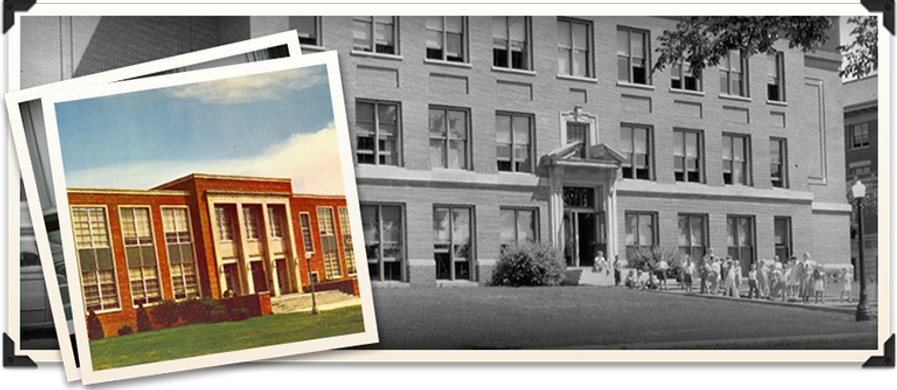
Our school and community provide us with opportunity for first-hand experience in democracy. In our small town is a red, rectangular-shaped building, which bears the name Teachers College High School. Every day students pass through the doors into their respective classes and are instructed in subjects which will be the most advantageous to them. They are free to indulge in arguments with instructors and fellow-students on any part of the class assignment--provided it is carried on in a courteous, clear-cut manner. It is the aim of Teachers High to give every pupil his chance to express his views.
Dramatic national and international events and movements in the next decades would test “The Spirit of Democracy” and change “spirit” to action.

Dr. Guy Wagner had just been named the new Head of the Iowa State Teachers College Department of Teaching and Director of the Campus School when the Japanese attack on Pearl Harbor on December 7, 1941 plunged the nation into war. Immediately, ISTC President Malcolm Price asked Wagner to serve on ISTC's Defense Board. Wagner and his fellow Board members were to provide advice and aid to students regarding military service. “These men stand ready to help in any way possible,” President Price explained. The Board's second duty was “to keep in touch with professional education groups relative to what can be done on this campus so that we may be able to render a professional service to our students and nation during this present emergency.”
Wagner's first move was to set up a parallel Campus School “Defense Council”—one of the first in the nation. It consisted of eleven Campus School seniors (including President Price's daughter, Nancy, who became the bestselling novelist). By early January 1942, the Campus School students were selling defense stamps and encouraging the whole school to conserve electricity, paper, and soap to make shortages less serious. Student Glendora Saack led a Campus School initiative to send boxes of food, books, and magazines to soldiers in the armed forces, “and especially to alumni.” In the fall, Wagner chaired a panel of ISTC professors discussing “Developing Global Understanding in the Middle and Upper Grades” and shared his views on “Educational Priorities in the Time of War” with the general public over KXEL radio.
By 1943, the Campus School had organized a “victory corps” focused on curricular and extracurricular activities geared toward winning the war. These included recycling waste, physical fitness activities, Red Cross work and other critical occupations. Wagner himself became chair of the local Red Cross camp and hospital committee which supplied materials to hospitals and military posts in the area. The magazine School Activities brought national attention to ISTC through Wagner's article on “The Campus School Program to Help Win the War.”
Another national magazine, Junior Arts and Activities, published Wagner's suggestions for “The Rural School in Wartime,” while Midland Schools, the publication of the Iowa State Education Association, published his article outlining “The Tasks Ahead.” In 1943 Wagner was also involved in a convention for Cedar Falls, Waterloo, and Hudson focused on “Children in War-Time and Afterward.” On the radio he spoke of sacrifices required.

With the end of the war and the beginning of the Cold War, Social Studies instruction continued its patriotic bent, but current events moved funding away from social studies toward math and science. Why? Sputnik, the world’s first artificial satellite, was launched by the Soviet Union in October 1957. Criticism of American Education in general and in technical education in particular, demanded an answer.
President Eisenhower, in his Message to Congress on January 27, 1958, called for matching educational programs with national defense needs and recommended the federal government play an important part in this activity. The National Defense Education Act of 1958 was the result, and it marked a turning point in education history. Save for the 1917 Smith-Hughes National Vocational Education Act, promoting vocational education in “agriculture, trades and industry, and homemaking,” the federal government had played a relatively small role in public education. This now would change, and the federal government would play a larger role, but not in Social Studies instruction, for the goal now of education was to catch the Soviet Union in math and science! The Act provided funding for student loans, fellowships, and various programs focused on Science, Mathematics, and Modern Foreign Languages. The NDEA also supported pre-college teacher training and public understanding of Science and Technology.
The Act authorized funding for four years, increasing funding each year: for example, funding increased on eight program titles from $183 million in 1959 to $222 million in 1960. In total, over a billion dollars was directed towards improving American Science and Math curricula. However, in the aftermath of McCarthyism a mandate was inserted in the Act that all beneficiaries must complete an affidavit disclaiming belief in the overthrow of the U.S. government. This requisite loyalty statement stirred concern and protest from the American Association of University Professors and 153 colleges.
In 1961 NDEA came up for renewal in Congress. The administration had recommended the addition of English and Physical Education for supplemental funding, but Social Studies remained absent. In response, NCSS launched an intensive effort to get “the social studies” included. NCSS argued that:
In the current crisis confronting our country, sustained and vigorous attention must be given to the fundamental role of the social studies in the education of American youth; ... a most vital ingredient in our educational program for our defense calls for an informed body of citizens, loyal to our traditions, who possess the ability to think clearly, and who can choose wise courses of action on the issues confronting our nation. (Greenawald, Dale, “Maturation and Change, 1947-1968,” Social Education, November/December 1995.) But once again the decision makers in Washington did not think that Social Studies was a priority.
Interestingly, the size of the MPLS Social Studies Department appeared to be impacted as well. In the 1952 Yearbook faculty photos, only two Social Studies faculty members are listed, while Math and Science each have four, along with Language Arts with six!


The trend gradually reversed course as the Social Studies Department increased to three faculty members the next year, and then enlarged to six in 1955. But other more monumental changes in Social Studies instruction were on the horizon.
Receive the latest news and updates in your inbox

Receive News and Updates
